Ai Weiwei
Ai Weiwei (b. 1957, Beijing, China) leads a diverse and prolific practice that encompasses sculptural installation, filmmaking, photography, ceramics, painting, writing and social media. A conceptual artist who fuses traditional craftsmanship and his Chinese heritage, Ai Weiwei moves freely between a variety of formal languages to reflect on the contemporary geopolitical and sociopolitical condition. Ai Weiwei’s work and life regularly interact and inform one another, often extending to his activism and advocacy for international human rights.
A global citizen, artist and thinker, Ai Weiwei moves between modes of production and investigation, subject to the direction and outcome of his research, whether into the Chinese earthquake of 2008 (for works such as Straight, 2008-12 and Remembering, 2009) or the worldwide plight of refugees and forced migrants (for Law of the Journey and his feature-length documentary, Human Flow, both 2017). From early iconoclastic positions in regards to authority and history, which included Dropping a Han Dynasty Urn and a series of middle-finger salutes to sites of power, Study of Perspective (both 1995), Ai’s production expanded to encompass architecture, public art and performance. Beyond concerns of form or protest, Ai now measures our existence in relation to economic, political, natural and social forces, uniting craftsmanship with conceptual creativity. Universal symbols of humanity and community, such as bicycles, flowers and trees, as well as the perennial problems of borders and conflicts are given renewed potency though installations, sculptures, films and photographs, while Ai continues to speak out publicly on issues he believes important. He is one of the leading cultural figures of his generation and serves as an example for free expression both in China and internationally.
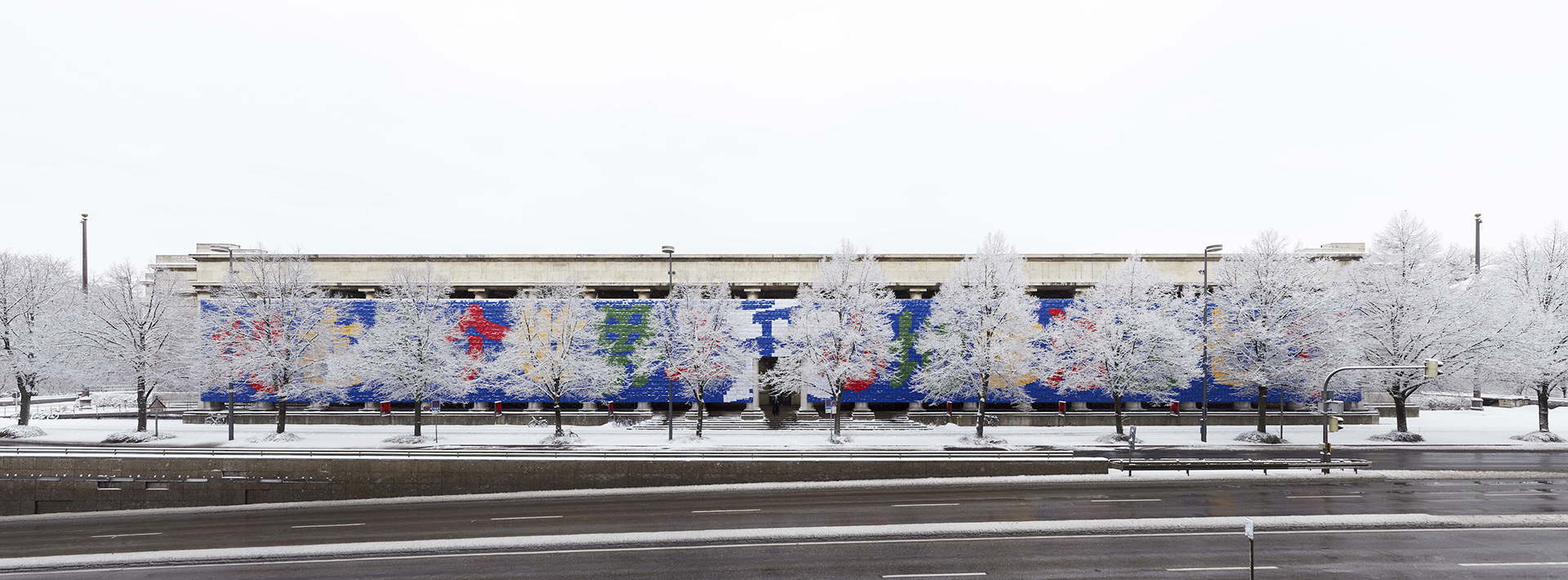
Ai Weiwei has exhibited extensively at institutions and biennials worldwide, including at Seattle Art Museum, Seattle (2025); MUSAC, León (2024); Design Museum, London (2023); Albertina Modern, Vienna (2022); Serralves Museum of Contemporary Art, Porto (2021); Kunstsammlung Nordrhein-Westfalen, Dusseldorf (2019); Oca – Ibirapuera Park, São Paulo (2018); Public Art Fund, New York (2017); Israel Museum, Jerusalem (2017); Palazzo Strozzi, Florence (2016); Andy Warhol Museum, Pittsburgh (2016); National Gallery of Victoria, Melbourne (2015); Royal Academy of Arts, London (2015); Martin-Gropius-Bau, Berlin (2014); Brooklyn Museum, New York (2014); German Pavilion, 55th Venice Biennale, Venice (2013); Hirshhorn Museum and Sculpture Garden, Washington DC (2012); Taipei Fine Arts Museum, Taipei (2011); Turbine Hall, Tate Modern, London (2010); Haus der Kunst, Munich (2009); Mori Art Museum, Tokyo (2009); documenta 12, Kassel (2007); and Kunsthalle Bern, Bern (2004).
Ai Weiwei’s architectural collaborations include the 2012 Serpentine Pavilion and the 2008 Beijing Olympic Stadium, with Herzog and de Meuron. Among numerous awards and honours, he received the Praemium Imperiale for sculpture from the Japan Art Association in Tokyo in 2022, won the lifetime achievement award from the Chinese Contemporary Art Awards in 2008 and was made Honorary Academician at the Royal Academy of Arts, London in 2011. His human rights work has been recognised through the Václav Havel Prize for Creative Dissent in 2012 and Amnesty International’s Ambassador of Conscience Award in 2015.
The artist’s memoir 1000 Years of Joys and Sorrows was published in 2021, and his autobiographical graphic novel Zodiac: A Graphic Memoir, in collaboration with Elettra Stamboulis and Gianluca Costantini, was published in 2024
Ai Weiwei lives and works in Beijing (China), Berlin (Germany), Cambridge (UK) and Lisbon (Portugal).